How Cheetahs Keep Their Heads Still While Sprinting
While the lovely valley teems with vapour around me, and the meridian sun strikes the upper surface of the impenetrable foliage of my trees.
The cheetah (Acinonyx jubatus) is the ultimate sprinter of the animal kingdom. But how does it manage to run so fast? And more importantly, how does it stay stable, keeping its head steady while its entire body is leaping forward at full speed?
The cheetah has been shaped by evolution for speed.
- He got.a a long, flexible body, with an extremely supple spine that acts like a spring with every stride, allowing the animal to cover remarkable distances in a single bound.
- Long, powerful legs, which lengthen the stride and maximize propulsion.
- Semi-retractable claws, functioning almost like cleats, giving the cheetah extra grip during sharp turns.
- And above all… a remarkable tail. It acts like a rudder, helping the animal maintain balance during sudden changes in direction
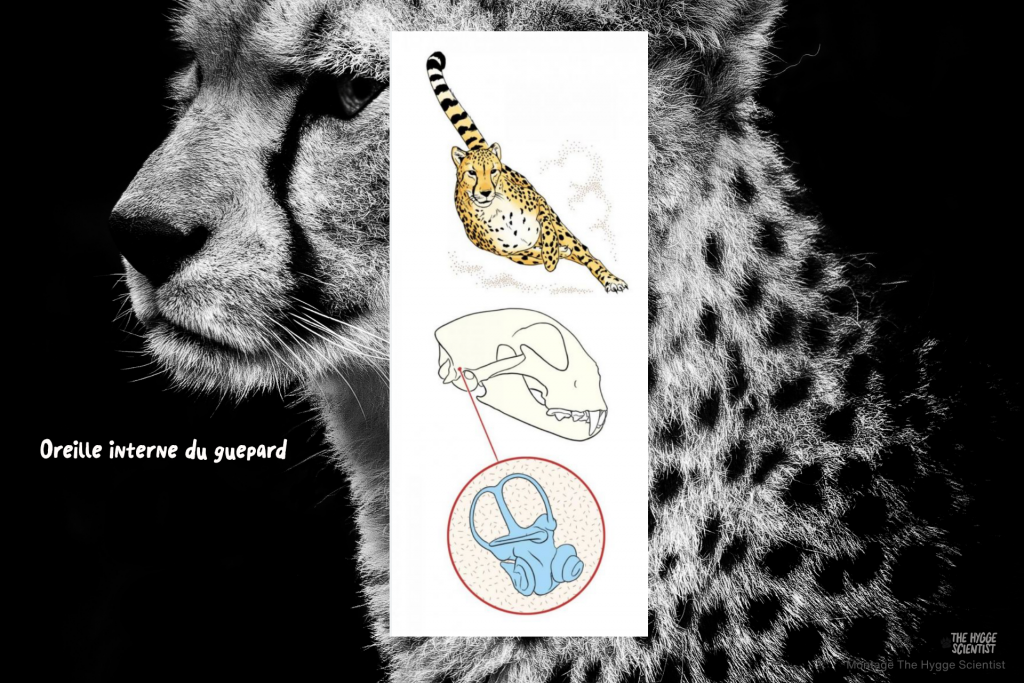
Inner ear source: Sciences et Avenir. Illustration: THS.
A study published in 2018 (Grohé et al. Scientific reports) used micro-CT scans to compare the cheetah’s inner ear anatomy with that of other felids. Cheetahs possess unusually elongated and enlarged semicircular canals in the inner ear, particularly in the horizontal and dorsal planes. These structures detect rapid changes in direction and posture with extraordinary precision, and even at high speed.
This anatomy functions like a highly refined gyroscopic system, stabilizing the head and allowing the cheetah to keep its gaze fixed on its target, even while its body leaps, twists, or brakes suddenly.